Addressing Italy’s digital capability gap in local government
Rethinking the State at the municipal level
Before diving in, I want to be precise about what is not the problem.
The Italian state has, in the space of roughly a decade, built one of the most sophisticated national digital infrastructures in Europe. Tens of millions of digital IDs have been issued, digital payments are being processed at scale, the IO app is a genuine, user-centric touchpoint; SEND is digitising official notifications and the National Digital Data Platform is enabling the implementation of the once-only principle across public administrations.
In short, Italy has invested heavily in national digital capacity. Yet, all main indicators on digital spend and adoption remain unsatisfactory, failing to improve the relationship between the state and citizens.
My argument is simple: capacity is a necessary but not sufficient condition for building capability. Capacity — or digital infrastructure — only becomes a dynamic capability when it is embedded in organisational routines, activated by skilled professionals, sustained by political coalitions, and when it generates learning that feeds back into reconfigured delivery. The digital infrastructure exists at the national level. The capability to integrate it, adapt it, and deploy it for citizens sits at the local level — and that is precisely where the bottleneck lies. A successful intervention would improve the state’s relationship with its citizens, constituting a genuine administrative and political win.
I will structure my argument in four parts. First, I will diagnose the problem, grounding it in data on Italy’s digital performance and the implementation record of the National Recovery and Resilience Plan. Second, I will address its structural causes. Third, I will propose a solution. And finally, I will be candid about the implications — for human resources, procurement, regulatory frameworks, and how we measure success.
Diagnosing the problem
The European Commission’s Digital Economy and Society Index paints a consistent picture. On e-government uptake — the share of citizens who actually use digital public services — Italy performs well below the EU average, and has done so for several years running.
This reflects a structural reality: services may exist on paper, but they are not reaching citizens. And critically, the gap is not uniform across the country — it is concentrated in smaller municipalities.
When we look at the availability and quality of digital services for citizens, Italy is in the same position. The services that exist at national level, delivered through platforms like IO and SPID, perform reasonably well.
The problem is that many of these services depend on local administrations to integrate them into their workflows, to customise them for local processes, and to promote them to citizens. That integration is not happening at the required pace or depth.
The picture for businesses is also troubling. Italian companies bear billions of euros per year in costs related to bureaucratic compliance and the majority of business owners describe themselves as oppressed by administrative requirements. When digital services fail to reach local government, it is not just citizens who suffer — it is the productive fabric of the Italian economy.
Quantifying the costs
Italy’s low ranking in the DESI index carries substantial economic costs.
Confindustria estimates the cost of digital inaction at 30 billion euros per year — roughly two percent of GDP. Conversely, the Politecnico di Milano calculates that a successful digitalisation of Italian bureaucracy would generate 25 billion euros annually in public value through reduced overhead, faster processing times, and improved compliance which would have a positive effect on tax receipts.
These are not marginal figures. They represent a fiscal and governance opportunity on the scale of a structural reform — without requiring new tax revenue or significant deficit spending.
For the private sector, the costs are equally stark.
80 billion euros per year in compliance costs for business; nearly three quarters of business owners reporting that bureaucratic burden is actively constraining their activity.
In the context of Italy’s struggles with productivity, which has been stagnant for the past 30 years, this is not a peripheral issue — it is central to the country’s economic trajectory.
NextGenerationEU as a diagnostic of digital capabilities in local government
The National Recovery and Resilience Plan can serve as a live diagnostic of institutional capability.
The funds were essentially a stress test of whether Italian administrations, at every level, could absorb, manage, and deploy resources for digital transformation. The results are instructive.
Italy’s PNRR allocates 6.14 billion euros to the digitalisation of the public administration.
This is a substantial commitment — covering sovereign cloud infrastructure, cloud migration for local government, data interoperability via the National Digital Data Platform, digital services, cybersecurity, and digital competencies.
| PNRR investments in PA digitalisation | Billions of euros |
|---|---|
| Digital infrastructure (National Strategic Hub) | 0.90 |
| Cloud migration for local government | 1.00 |
| Data and interoperability | 0.65 |
| Digital services and digital citizenship | 2.01 |
| Cybersecurity | 0.62 |
| Digitalisation of large central administrations | 0.61 |
| Basic digital skills | 0.20 |
| Support for local administrations’ transformation (reform) | 0.16 |
| Total | 6.14 |
On paper, the design is coherent and ambitious and systemic, but as the indicators above show, there is a stark contrast between paper and reality.
By February 2023, local administrations, mostly municipalities, had turned down 251 million euros of allocated PNRR funding — not because the money was insufficient, not because the ambition was wrong, but because local administrations lacked the organisational capability to absorb it.
This is the core of the problem. We are not dealing with a resource constraint. We are dealing with a capability constraint.
The cloud migration for local government investment provides perhaps the starkest illustration of this. By December 2024, of the one billion euros budgeted, around 833 million had been assigned to projects, but only 115 million had been spent.
Of the 6,740 projects due to finish by 2024, only 2,204 — about one in three — had reported any spending.
| Cloud migration for local government, December 2024 | |
|---|---|
| Budget | €1,000m |
| Assigned to projects | €833m |
| Spent | €115m |
| Projects in total | 12,375 |
| Projects due to finish by 2024 | 6,740 |
| Of which with spending reported | 2,204 |
This is because cloud migration requires local IT offices to plan, tender, and manage complex transitions. Each of these steps requires organisational capability that, in the majority of Italian municipalities, simply does not exist in sufficient depth.
It can therefore be said that the gap between appropriation and expenditure is a direct consequence of local administrations’ capability gaps.
Why is this happening?
So why is it happening? The answer lies in the institutional organisation as well as architecture of Italian local government.
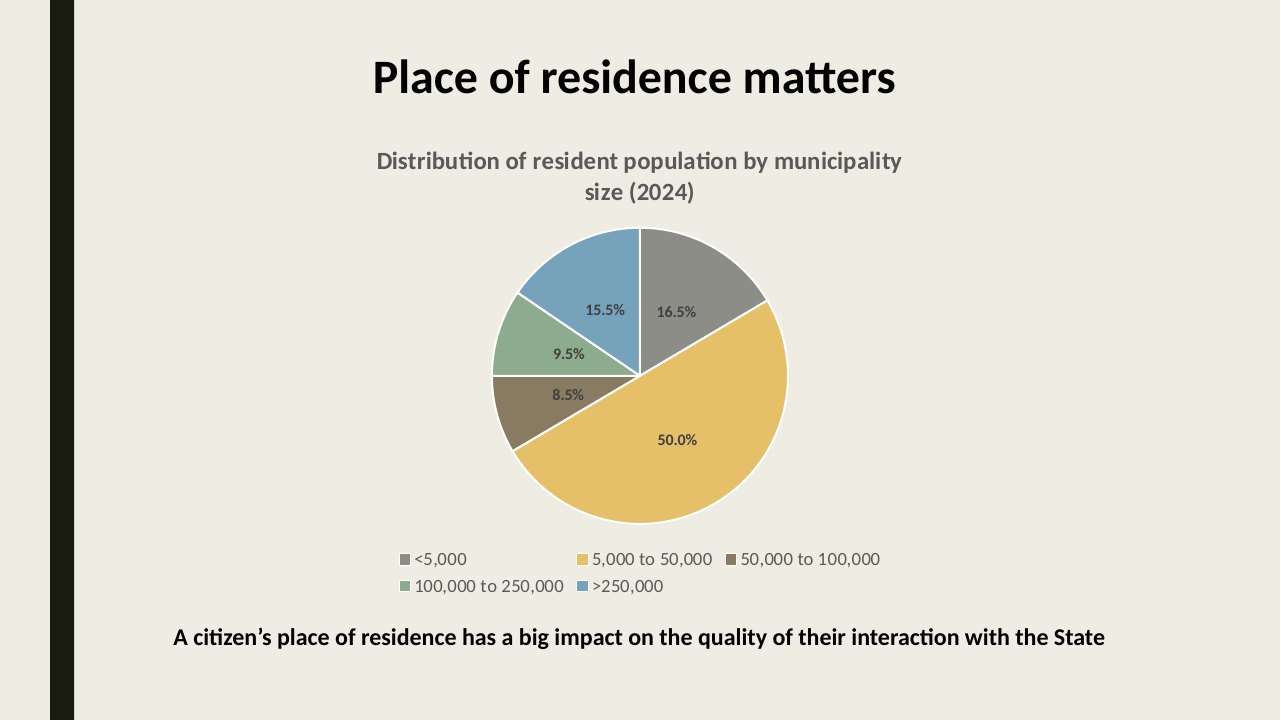
Italy has roughly 7,900 municipalities. Approximately 16.5 percent of the population lives in municipalities with fewer than 5,000 inhabitants; fully half lives in municipalities between 5,000 and 50,000. This demographic geography matters enormously: the smaller the municipality, the thinner its administrative capacity, the narrower its tax base, and the harder it is to attract and retain technically skilled staff.
A citizen’s postcode, in other words, is a reliable predictor of the quality of their interaction with the state.
On paper, the organisational model looks coherent. The Italian Digital Administration Code, updated progressively since 2005, requires every public administration to appoint a Digital Transformation Manager with a dedicated office reporting to the Secretary General.
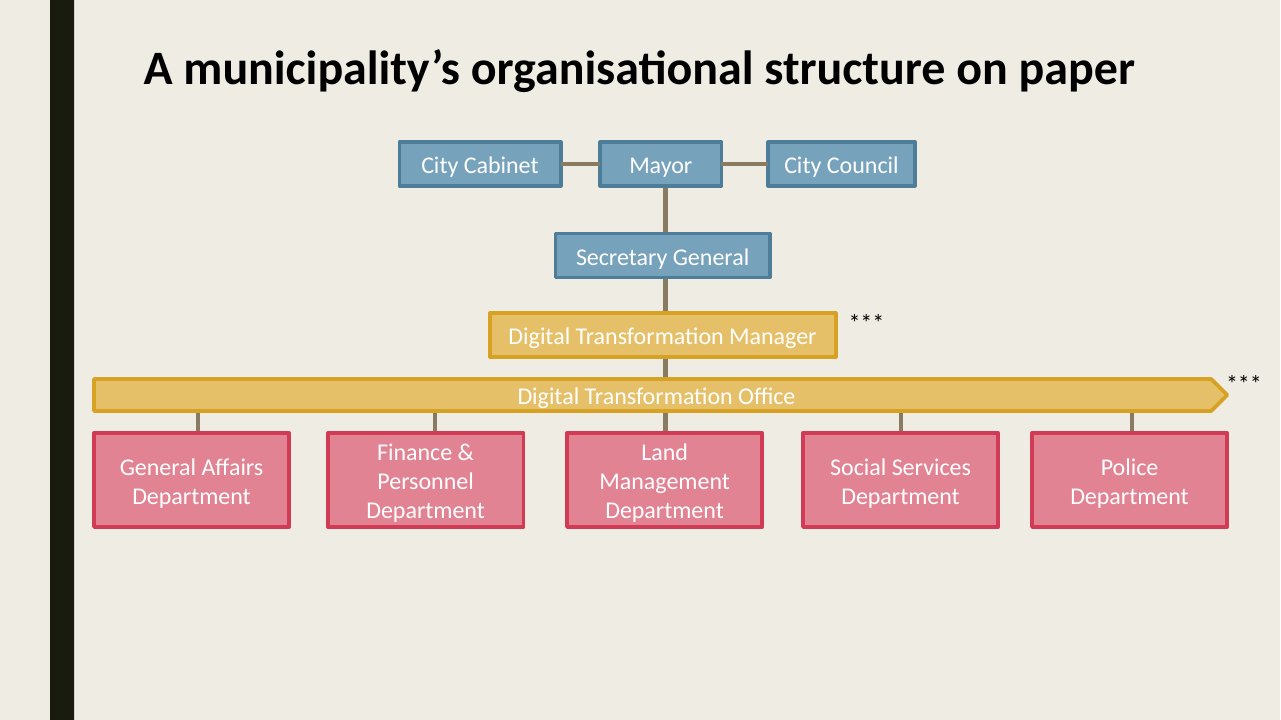
The DTM is mandated with a plethora of responsibilities, making the role ill-suited for smaller municipalities.
The reality is rather different. As of early 2024, 1,034 of Italy’s 7,900 municipalities — 13 percent — had not appointed a DTM at all, despite this being a legal requirement since 2016.
In municipalities where a DTM has been appointed, the role is typically held by an existing official as a secondary responsibility, with no dedicated budget, no supporting staff, and limited political backing. What is on paper a powerful function of strategic digital leadership is in practice, in the vast majority of Italian municipalities, a formality — a compliance checkbox rather than an organisational reality.
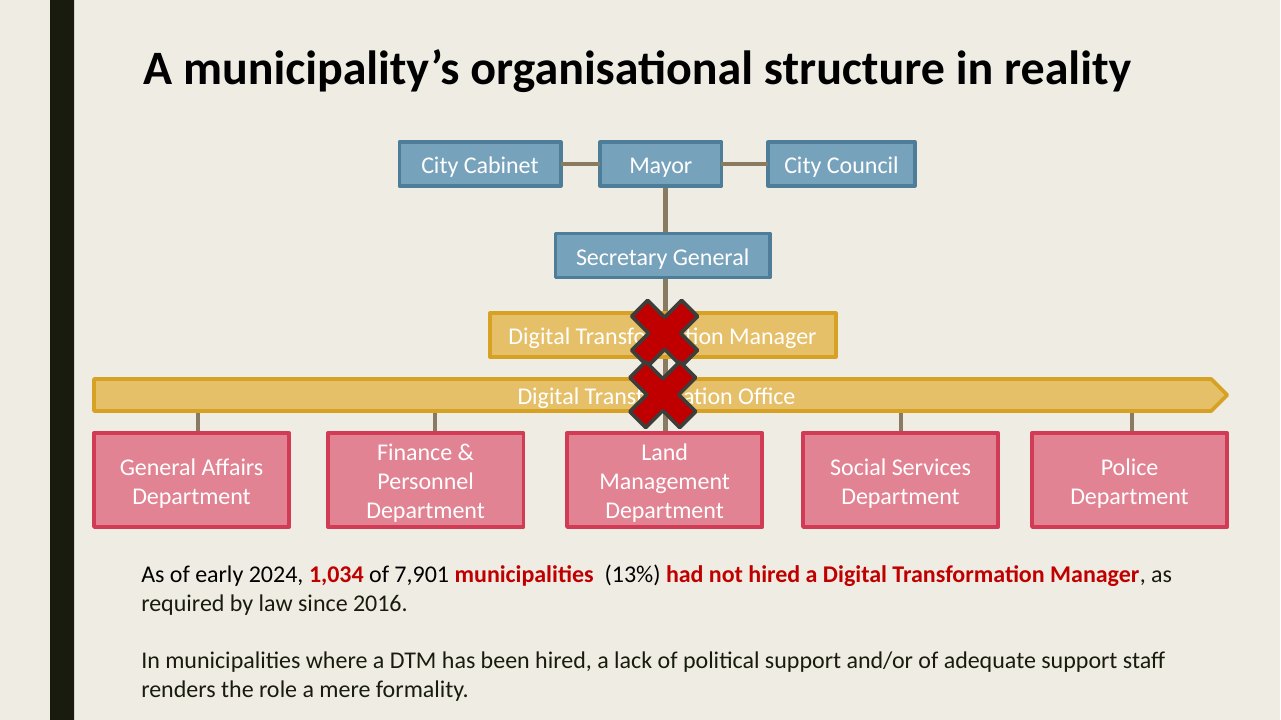
There is therefore a significant gap between de jure and de facto institutional capacity.
This is the current scope of the Digital Transformation Office’s responsibilities:
- Strategic coordination of ICT systems development
- Direction and coordination of internal and external digital service development
- Planning & monitoring of cybersecurity for data, systems and infrastructure
- Promotion of accessibility and digital inclusion for people with disabilities
- Evaluation of ICT alignment to improve service quality, efficiency and costs
- Support for administrative reorganisation processes
- Planning & management oversight of ICT systems
- Design and coordination of inter-administration digital service initiatives
- Coordination of digital identity, protocols, e-signatures and interoperability
- Planning and coordination of ICT procurement aligned with the digital agenda
Considering that these are non-trivial tasks for large, better resourced municipalities, imagine what they mean for smaller, understaffed ones.
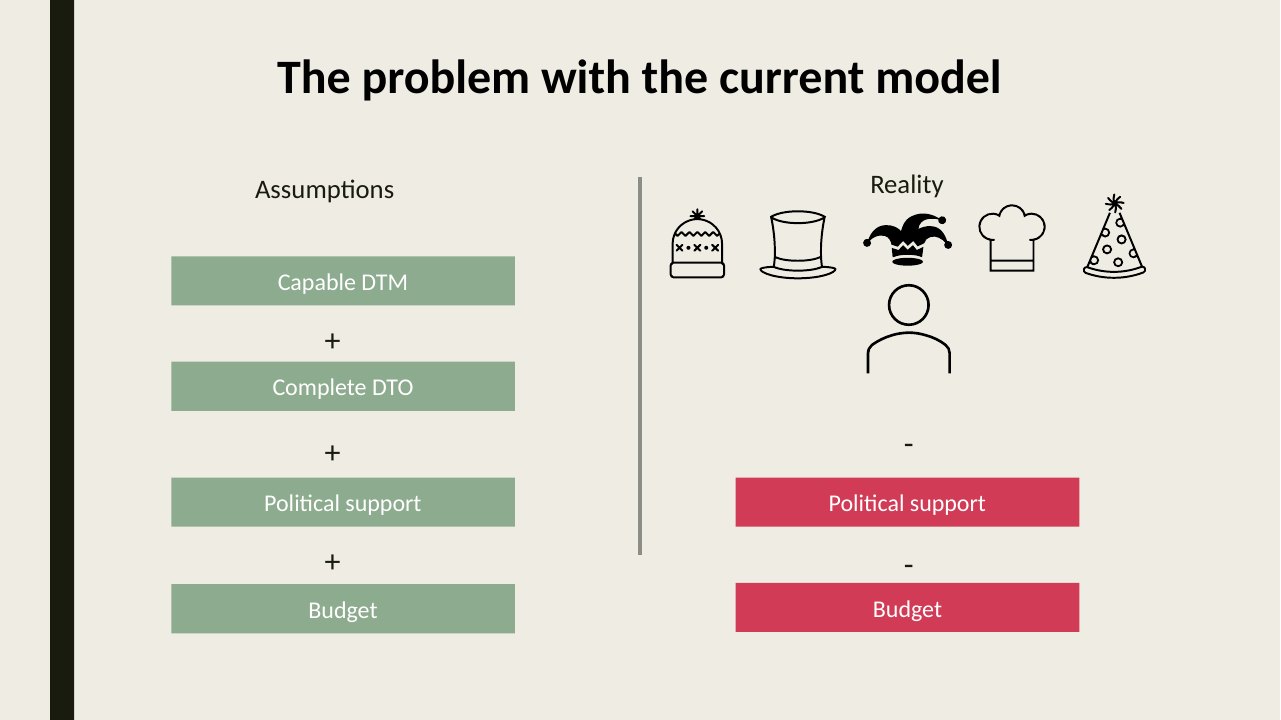
The assumptions embedded in the current model are, in short, heroic. The model presupposes a capable, full-time DTM with complete support staff, adequate budget, and active political backing. The reality is that because of the compliance nature of this model, political backing for DT initiatives is usually low, rendering the function largely ceremonial.
Addressing the problem
So how can we address this issue?
I want to draw on a comparative case that I believe is particularly instructive for Italy’s situation: the UK’s Government Digital Service, and its recent Local Government extension.
The GDS was established in 2011 with a clear mission: to lead the UK’s digital transformation by building enabling layers, setting standards, and pioneering user-centred design principles across central government digital services.
Over a decade, it became one of the most influential digital government organisations in the world — not because of its budget, but because it developed distinctive organisational routines: agile delivery, user research as a gate to service development, iterative service reviews at every stage of the lifecycle. These are exactly the kinds of routines that are constitutive of dynamic capability.
In 2025, GDS extended its remit explicitly to local government through GDS Local — a programme structured around three areas: developing a strategic vision for local government technology; unlocking local data potential; and making GDS products available to local authorities.
The model is relevant to Italy for a specific reason: it represents an attempt to bridge the capability gap between central digital infrastructure and local delivery capacity. Rather than simply mandating that local authorities comply with central standards, GDS Local invests in building the capability of local organisations to use those standards productively.
The six objectives of GDS Local are instructive as a template. They encompass: supporting local authorities to scale digital innovation; promoting shared standards across local and central government; making public services simpler and more joined-up; sharing knowledge and best practices; exploring new approaches together, and encouraging learning networks to build skills and experience across local and national teams.
What is notable is the balance between standard-setting and active capability support — between the normative and the developmental functions of a central digital agency.
GDS and AgID
This brings us to the comparison that is most directly relevant: GDS versus AgID. Both are central digital agencies with broadly similar mandates. Both oversee digital infrastructure, set standards, and are responsible for the digital transformation of their respective public administrations. But their organisational cultures, their relationships with local government, and their approaches to delivery are quite different.
| GDS | AgID |
|---|---|
| Agile delivery | Standard-setting |
| User research as a gate | L&T compliance checks |
| Procurement for all | Procurement for enterprise |
| Service reviews at every stage | Ex-post monitoring |
| Active listening infrastructure | Sensing through reporting |
| High central/local connection | Low central/local connection |
| Shaping through agency | Shaping through compliance |
GDS operates through an active listening and agile delivery culture. User research is a gate: services cannot progress to the next phase of development without evidence that they meet user needs. Procurement is open and iterative. Service reviews happen at every stage, not just at the end. The organisation senses problems through ongoing feedback loops, not through periodic compliance reporting.
AgID, by contrast, operates primarily through standard-setting and ex-post monitoring. It issues guidelines, mandates compliance, and audits adherence. It shapes behaviour through compliance rather than through agency. The central-local connection is essentially centred around reporting, not meaningful interaction. To be clear, this is not a criticism of AgID — it reflects a genuine institutional choice about what a central digital agency is for.
This comparison points to what I believe is the critical missing piece in Italy’s current model. Between the active listening infrastructure that GDS has built — with its high central-local connection, its ability to shape outcomes through agency — and AgID’s current mode of shaping outcomes through compliance, there is a significant organisational gap. The national digital infrastructure is in place. The local capability to engage with it, adapt it, and deploy it is not.
The solution I am proposing attempts to bridge that gap — not by replacing AgID, but by creating a new organisational layer that brings capability to where it is most needed.
A new path forward: Regional Digital Capability Hubs
My proposal is for a national network of Regional Digital Capability Hubs.
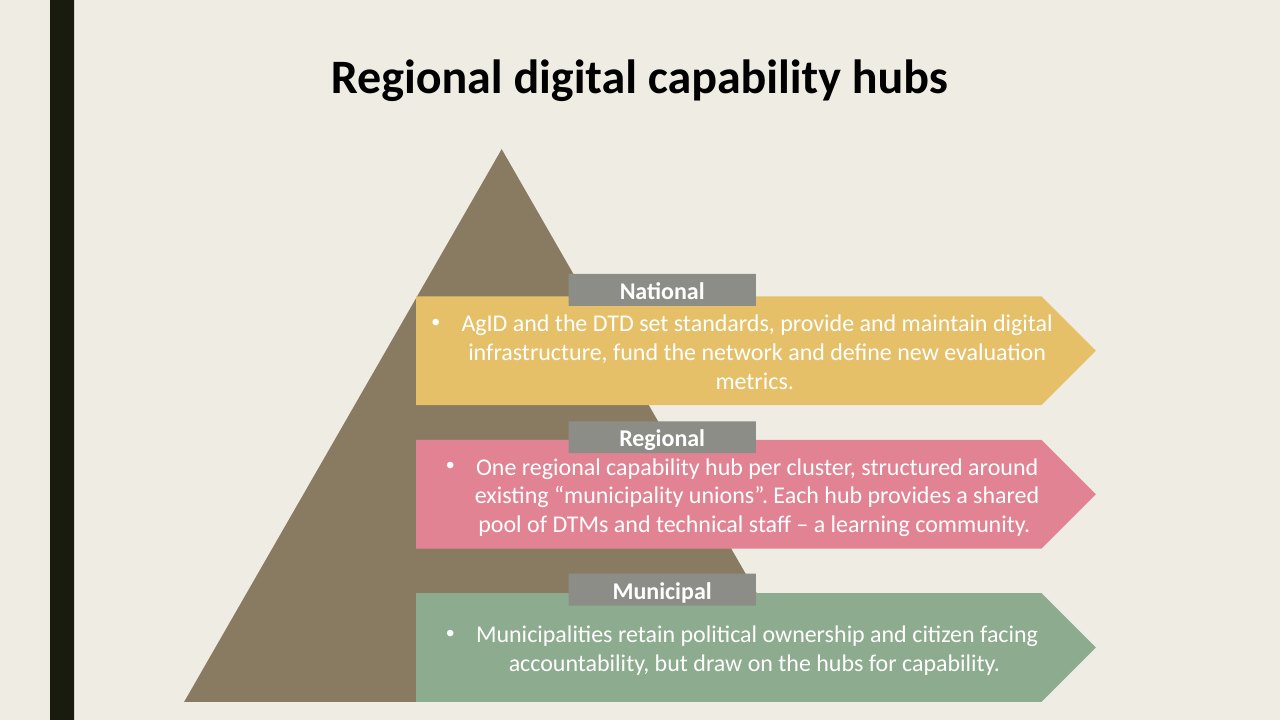
The hub model operates across three levels.
At the national level, AgID and the Department for Digital Transformation continue to set standards, maintain and develop digital infrastructure, fund the hub network, and define new evaluation metrics, shifting in part from compliance enforcement to standard-setting and capability investment.
At the regional level, one hub serves each geographic cluster, structured around Italy’s existing unioni di comuni — the municipality unions that already provide a legal and administrative basis for shared services. Each hub houses a shared pool of Digital Transformation Managers, user researchers, service designers, data engineers, and procurement specialists. Crucially, this should be designed as a learning community — a place where routines can be developed, tested, and refined across multiple municipalities simultaneously, allowing for the sharing of best practices.
At the municipal level, municipalities retain full political ownership and citizen-facing accountability. The mayor remains responsible to citizens for the quality of local services. But the municipality can now draw on the hub for the technical and professional capability that it cannot sustain independently.
Building dynamic capability through coalitions
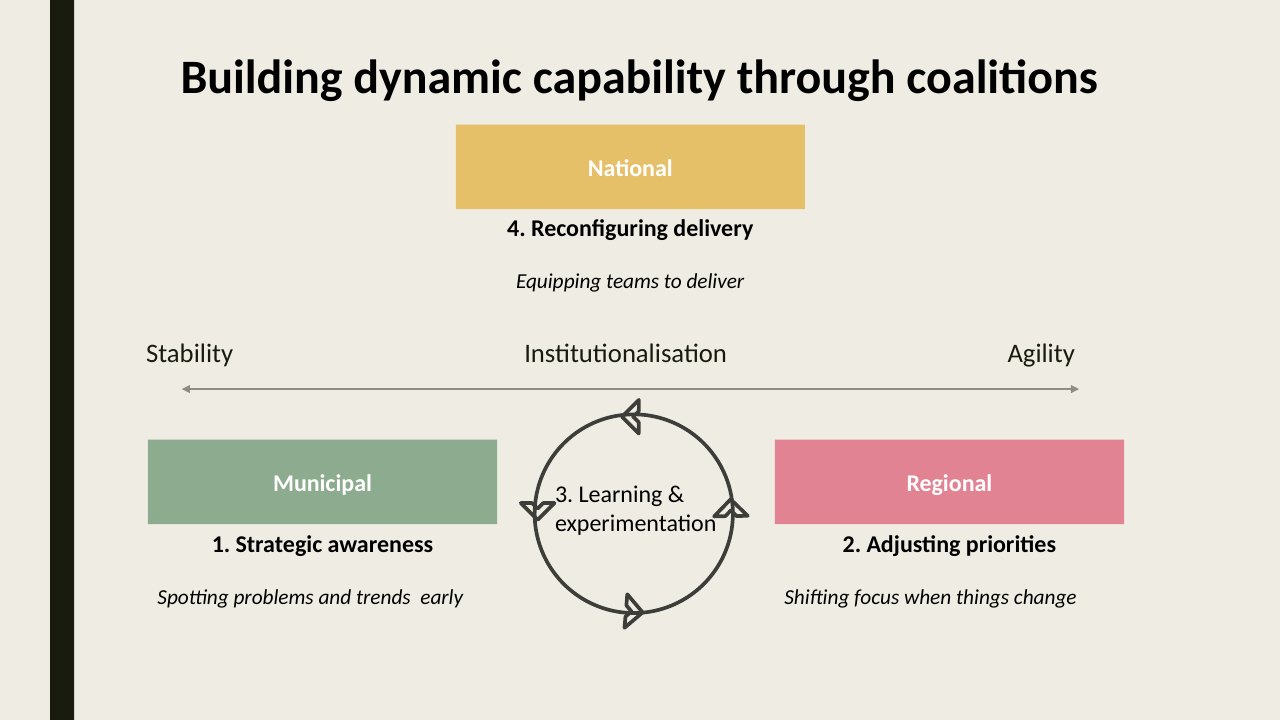
The hub model can be mapped directly on the dynamic capability framework.
Strategic awareness is built at the municipal level, where front-line staff are closest to citizen experience. The hub provides the analytical tools and the forum to surface that intelligence systematically.
Adjusting priorities is enabled by the regional hub’s ability to reallocate resources rapidly across the cluster when a municipality encounters an unexpected challenge.
Learning happens by aggregating experimentation across multiple municipalities. This way, the hub creates a learning loop that no individual small administration could sustain alone. A pilot in one municipality becomes a template for others; a failure in one context can shape practice elsewhere.
The reconfiguration of delivery happens as the hub embeds new routines into municipal workflows, while in parallel, AgID and the Department for Digital Transformation will update their guidelines accordingly.
Finally, the success of this new institutional arrangement rests on the ability of this national, regional and municipal network to coalesce around a shared objective, creating a central-local feedback loop that currently does not exist.
Implications and challenges
Let me now be direct about what this model requires — in terms of human resources, regulatory reform, and new ways of measuring success. These are not afterthoughts. In some ways, this is the hardest part.
Human resources
The hub model requires professional profiles that do not currently exist in significant numbers in Italian public administration: user researchers, service designers, procurement specialists capable of managing iterative contracts, data engineers, and digital project managers with experience of agile methodologies.
My proposal is to institutionalise these roles through an Italian equivalent of the UK’s Digital Data and Technology professional framework.
This framework, first introduced in 2016/17, institutionalised digital roles in the UK, creating a professional identity and a career path that made digital roles in government genuinely attractive.
For Italy, this would mean a legislative or regulatory act — potentially a PM’s decree — establishing digital profiles for the public sector.
The framework would define, at a national level:
- Standardised job titles — so that a service designer in Milan and a service designer in Palermo hold comparable roles, with comparable skills, comparable pay, and comparable career prospects.
- Pay bands that are competitive within the constraints of public sector budgets.
- Career progression pathways that allow a junior user researcher in a hub to progress to a senior role, and potentially into central government — creating cross-government mobility and preventing dead-ends.
The hubs could initially be staffed primarily through secondment from central bodies. Over time, as the framework embeds and career pathways become credible, a permanent pipeline of digital professionals should emerge.
Procurement
The second major implication concerns procurement. Italy’s public procurement code has undergone significant reform in recent years, shifting in principle towards outcome-based commissioning. But a few barriers remain — and they are barriers that undermine the delivery model required by digital transformation.
The first one is fear of signature — the pressure that individual officials face when they define contracts without a closed and exhaustive scope. Under current practice, commissioning a project without specifying exactly what will be produced at the end risks personal legal exposure. This creates a powerful incentive to over-specify contracts upfront, eliminating the flexibility that iterative digital delivery requires.
The second is the strict modification rule: substantial changes to a contract may require a new tender. In a digital service development context, where the discovery phase almost always reveals that the original assumptions were wrong, this could be a problem.
The third is budgetary rigidity: the requirement for a clearly defined total upfront cost. This is incompatible with outcome-based contracting models and prevents agile delivery of digital services.
Addressing these barriers requires changes at multiple levels. At the legislative level, a targeted amendment to the Codice dei Contratti Pubblici could explicitly carve out a category of contratti agili per servizi digitali — agile digital service contracts.
At the regulatory level, ANAC guidance could clarify the liability position of officials who define iterative contracts in good faith.
And at the cultural level — perhaps the most important — training for public officials on what responsible risk-taking in procurement actually looks like is essential.
Measuring success
Along with these modifications, we need to change the way in which we measure success. The current measurement framework for Italy’s digital transformation is essentially binary, capturing compliance and turning into a box-ticking exercise, but saying almost nothing on the administrations’ ability to sense citizen needs and deliver good services.
By tracking user satisfaction scores, the number of service reviews conducted and the depth of adoption by municipalities of digital enabling layers developed by central government, we can shape institutional behaviour. Assessing a municipality’s digital performance on – for instance – user satisfaction with digital services, rather than on whether a DTM has been appointed, would radically change the way in which the mayor of that municipality thinks about digital transformation.
Conclusion
Italy has built the infrastructure. PagoPA, SPID, IO, PDND, SEND — these are genuine achievements. The risk now is not that the infrastructure fails. The risk is that it succeeds technically and fails socially because the organisations closest to citizens lack the capability to connect it to their lives.
Regional Digital Capability Hubs are not a radical institutional invention. They are a targeted response to a specific capability gap, built on existing legal structures and comparative evidence. They require investment — in people, in procurement reform, in new metrics. But the alternative is to leave 30 billion euros of annual public value on the table, and to allow a once-in-a-generation infrastructure investment to fall short of its promise at the last mile.